

Assessment
What Assessment is and Why it Matters
Assessment at Polk State College is an ongoing process used to evaluate how well programs, services and initiatives are achieving their intended outcomes and to identify opportunities for improvement.
Through assessment, academic and administrative areas collect and analyze meaningful evidence to understand performance, measure results and inform decisions. This process supports student learning, strengthens programs and services and promotes accountability across the College.
Assessment is not a one-time activity or a compliance requirement. It is a continuous cycle of setting outcomes, measuring results, reflecting on findings and using evidence to guide improvements. By consistently reviewing and acting on assessment results, Polk State College ensures that decisions are data-informed and focused on effectiveness and student success.
At its core, assessment helps the College answer key questions:
- Are students achieving the expected learning outcomes?
- Are programs and services effective in meeting their goals?
- How can evidence be used to improve outcomes and guide future actions?
Assessment at Polk State College supports a culture of continuous improvement by connecting evaluation, planning and meaningful change.
What the College Assesses
Polk State College assesses multiple areas to ensure a comprehensive understanding of effectiveness and impact, including:
- Student learning outcomes
- General education and core curriculum outcomes
- Program learning outcomes
- Student support and administrative services
- Institutional priorities and strategic goals
Multiple measures are used across these areas to evaluate performance and guide improvement.
How Results are Used for Improvement
Assessment results are used to:
- Improve student learning and success
- Strengthen academic programs and services
- Inform planning, budgeting and resource allocation
- Support institutional reporting and accreditation requirements
Assessment at Polk State College is evidence-driven, collaborative and focused on improvement—not evaluation of individual performance.
Assessment Cycle at Polk State College
Planning → Evidence → Action
Assessment at Polk State College follows a structured, institution-wide cycle that connects planning, evaluation and improvement.
Polk State College’s Institutional Effectiveness Cycle (adopted AY 2022–2023) includes:
- Strategic Planning
- Assessment
- Analysis
- Action
- Implementation
- Review & Adjustment
- Continuous Improvement
- Documentation & Reporting
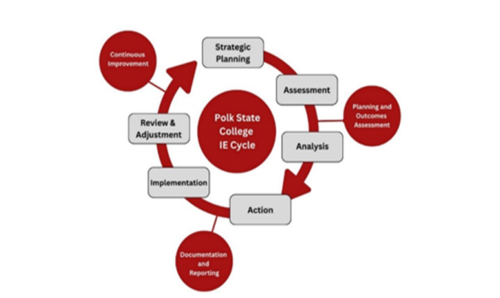
Assessment results are used to guide decisions, strengthen programs and services and “close the loop” by evaluating the effectiveness of implemented improvements.
+ General Education Assessment
What it is at Polk State College
General Education Assessment evaluates how well all students—regardless of major—achieve the College’s core general education learning outcomes. This assessment ensures that foundational skills are intentionally developed, reinforced, and measured across the curriculum as part of Polk State’s commitment to student success and continuous improvementCore learning outcomes for all students
Polk State College has identified five General Education Outcomes (GEOs) that apply to all Associate of Arts students:
- Communication
- Critical Thinking
- Scientific and Quantitative Reasoning
- Information Literacy
- Global Socio-Cultural Responsibility
These outcomes reflect the College’s mission and define the essential knowledge and skills students are expected to demonstrate upon completion of general education coursework
How General Education outcomes are assessed
Faculty teaching general education courses collaboratively:
- Define specific General Learning Outcomes (GLOs) aligned to the five GEOs
- Select direct assessment measures (embedded assignments, exams, projects, rubrics)
- Establish benchmarks for student achievement
- Collect and analyze results annually
Assessment results are reviewed through the College-wide Assessment Committee structure and are documented as part of Polk State’s annual outcomes assessment process
Reinforcement across courses and disciplines
General Education outcomes are intentionally scaffolded:
- Introduced in early-level courses
- Reinforced in multiple disciplines
- Strengthened through repeated application across programs
This approach ensures students develop transferable skills while supporting coherence across the curriculum and alignment with institutional learning goals
+ Annual Program Assessments
What it is at Polk State College
Academic and Administrative Assessment is the annual process through which instructional programs and administrative units evaluate effectiveness, document results, and use evidence to drive improvementProgram Learning Outcomes (PLOs)
Academic programs identify:
- A clear purpose aligned to the College mission
- At least two Program Learning Outcomes
- Direct measures and achievement targets
Faculty assess student mastery of PLOs annually using embedded course assignments mapped at the introduced, reinforced, or mastery level
Administrative Goals & Objectives
Non-instructional units define:
- Operational or service-based outcomes
- Measures of effectiveness
- Benchmarks for success
These outcomes ensure administrative services meaningfully support student success, institutional efficiency, and strategic priorities
Aggregated, program-level results
Assessment results are:
- Collected annually
- Aggregated at the program or unit level
- Analyzed for trends, strengths, and gaps
The Office of Institutional Effectiveness, Accreditation and Research (IEAR) compiles college-wide summaries to support transparency and accountability
Use of results for curriculum and program improvement
Programs are required to demonstrate how results are used through documented action plans, which may include:
- Curriculum revisions
- Instructional changes
- Additional learning supports
- Process improvements
This “closing the loop” step is central to Polk State’s Institutional Effectiveness Cycle and continuous improvement model
+ 5-Year Program Reviews
What it is at Polk State College
Program Review is a structured, comprehensive evaluation process that occurs on a five-year cycle for both academic programs and administrative unitsPeriodic, comprehensive program evaluation
Every five years, programs conduct an in-depth self-study examining:
- Mission alignment
- Student learning or operational outcomes
- Enrollment, completion, and workforce data
- Resource needs and program health
This review goes beyond annual assessment by examining longitudinal evidence
Use of assessment data and other evidence
Program reviews integrate:
- Five years of assessment results
- Advisory committee feedback (where applicable)
- Curriculum changes
- Faculty and staff contributions
- Institutional Research data
This ensures decisions are grounded in evidence rather than anecdote
Support for planning, improvement, and accountability
Results of Program Review:
- Inform strategic and resource planning
- Identify strengths and improvement priorities
- Are peer-reviewed and formally documented
- Include follow-up reporting to ensure progress
Findings are shared with leadership and contribute to institutional accountability and accreditation compliance
+ Assessment Resources & Tools
What it is at Polk State College
Assessment Resources & Tools provide centralized support to ensure faculty and staff can effectively participate in planning, assessment and continuous improvement activitiesAssessment contact information
The Office of Institutional Effectiveness, Accreditation and Research (IEAR):
- Serves as the primary assessment support office
- Provides consultation, data, training, and reporting assistance
- Coordinates College-wide assessment and program review activities
Guidance for employees
Faculty and staff receive guidance on:
- Writing outcomes and measures
- Selecting appropriate assessment methods
- Interpreting results
- Developing actionable improvement plans
This support ensures consistency, quality, and alignment across all assessment efforts
IEAR SharePoint resources in PIE
Assessment templates, timelines, training materials, and reference documents are housed on the IEAR SharePoint site within PIE.
- Reference: IEAR SharePoint site (College login required).
These tools support standardized documentation and efficient collaboration across academic and administrative units