

Polk State Aerospace Symposium connects students with aviation leaders
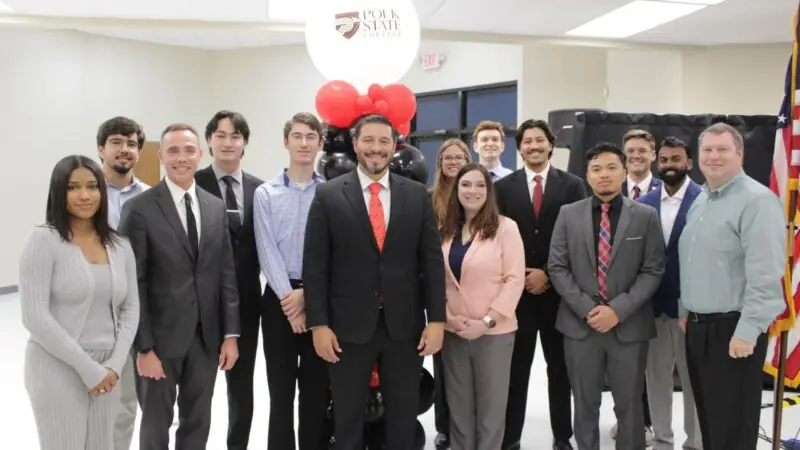
Preparing for an aviation career means learning how to work with people, navigate government organizations, and adapt as technology changes.
At Polk State College’s inaugural Aerospace Symposium on Tuesday, students heard how those skills shape the daily work of leaders at local airports.
The event at the Aerospace Center for Excellence in Lakeland brought students together with industry leaders to talk about career paths, workplace challenges, and opportunities to gain experience before graduation.
The symposium reflects the principles of Polk State President Anastasios Kamoutsas’ Where Eagles Soar initiative which focuses on strengthening workforce education through innovation and partnerships, ensuring students of all backgrounds can achieve greatness, and developing responsible citizens. The event brought those goals together by helping students understand both the technical demands of careers in aviation and the relationships and public decisions that support it.
“Aviation careers are built on more than just technical skills,” President Kamoutsas told students in attendance at the symposium. “They’re built on relationships, industry knowledge, and a commitment to safety. Take advantage of today’s event to connect with the people who can help shape your future.”
The audience included students from Polk State College, Central Florida Aerospace Academy’s Winter Haven and Lakeland locations, Ridge Community High School, Mulberry High School, and Lake Wales High School.
Retired U.S. Air Force Major General Jake Polumbo moderated a panel which included Adam Lunn, director of Lakeland Linder International Airport; Troy Heidel, director of Winter Haven Regional Airport; and Jayme Jamison, program coordinator for Bartow Executive Airport, who described how they entered the industry and what students can do now to prepare.
A common theme emerged: technical knowledge becomes more valuable when employees can communicate, solve problems together, and understand how decisions are made.
For Heidel, a Polk State graduate who earned his associate degree in Aerospace Administration in 2018 and a bachelor’s degree in the field in 2020, becoming an airport director meant learning about governance and how to navigate the process of getting things done.
“The biggest learning curve I had as an airport director was working with the commission and working with the city manager,” Heidel said. “They don’t teach you that stuff in college.”
Jamison agreed, emphasizing how legislation, public policy, and regulations shape the work of the aviation industry.
“A lot of what you do at the airport, day in and day out, is not in a textbook,” she said. “So my best advice would be to make yourself as well-rounded as possible.”
She encouraged students to begin developing those skills while still in school. Participating in student government, attending a city commission meeting, and observing how people work through disagreements can help students understand the decision-making process at airports.
Lunn emphasized the importance of planning and teamwork, especially in an industry where the economic impact is rapidly growing.
“It’s been determined that Lakeland Linder’s economic impact to our entire region annually is around $1.5 billion,” he said. “That’s billion with a B. They’re looking at everything from the jobs that are created on the field to the jobs that are downstream, construction activity, and investments on property.”
Managing that work also requires relying on others. Lunn stressed the importance of delegating and trusting the expertise of staff members.
“You need to find great folks who you can surround yourself with, who you can continue to ask questions, rely on, bounce things off of,” Lunn said.
Technology added another dimension to the conversation, including artificial intelligence and the changing systems students may encounter in the industry.
At Bartow Executive Airport, a digital air traffic control tower is already changing how controllers monitor airport activity. The airport is among the first in the nation to operate the technology, which uses cameras and digital displays to provide a 360-degree view. Digital towers are considered a lower-cost alternative to conventional tower construction that could extend air traffic control services to rural and community airports.
Winter Haven Regional Airport is also preparing for a digital tower system that will allow Federal Aviation Administration (FAA)-certified air traffic controllers to monitor aircraft movements and provide instructions to pilots remotely from Bartow.
Jamison explained that the equipment creates work beyond air traffic control. Servers, electronics, and other systems require people who can maintain them and respond to technical issues.
“It has servers that need to be repaired and maintained,” she said. “If something goes down or it needs maintenance, those are very specific and skilled engineering jobs.”
The panelists encouraged students explore the range of career opportunities in aviation and take advantage of opportunities to gain experience.
Lunn said Lakeland Linder is developing an internship program that will include Polk State students and encouraged them to pursue job shadows.
His own interest in airport management began with a one-day job shadow in high school. He urged students to find people they can ask questions, learn from, and turn to throughout their careers.
“Surround yourself with good people, folks who can help you along the way, because you’re going to need it,” he said. “And it’s a team sport. You can’t do it alone.”
For Stella Nawyn, a Polk State Aerospace student, Cadet Major for the Civil Air Patrol, and Deputy Cadet Commander of the MacDill cadet squadron, who served as the symposium’s student announcer, hearing from the panelists highlighted the breadth of careers in the industry.
“Aviation in general is so multifaceted,” she said. “We think about pilots getting the spotlight a lot of the time, but we don’t get to hear from airport directors or program coordinators.”
Several students stayed afterward to speak with the panelists, Kamoutsas, and faculty, beginning the kinds of conversations the event was designed to encourage.
Those connections are part of a broader effort by Polk State to help students move from the classroom into employment.
Recent initiatives include the partnership with Florida Department of Transportation through which the College serves as the lead partner to provide training and credentialing in Advanced Air Mobility technology, as well Polk State’s Eagle to Phoenix Pathway with Florida Polytechnic University which creates a route to 10 STEM bachelor’s degree programs, including aerospace engineering. Together, these partnerships connect students with further education and the industries developing around them.
Polk State’s Aerospace Program is already producing strong outcomes with a 100% FAA exam pass rate, and 92% of graduates employed in the industry or continuing their education. The College also offers in-state tuition well below the national average and the Bachelor of Science in Aerospace Sciences Program specifically has earned a Best Value School recognition due to its quality and affordability.
“No matter where a student’s aspirations may take them, they are building a strong foundation here in this community at Polk State College,” said Kamoutsas, “Aviation is a field in which relationships matter, and it is full of opportunity right here in Polk County.”