

Polk State Professor Ellis remembered as devoted educator, fearless advocate
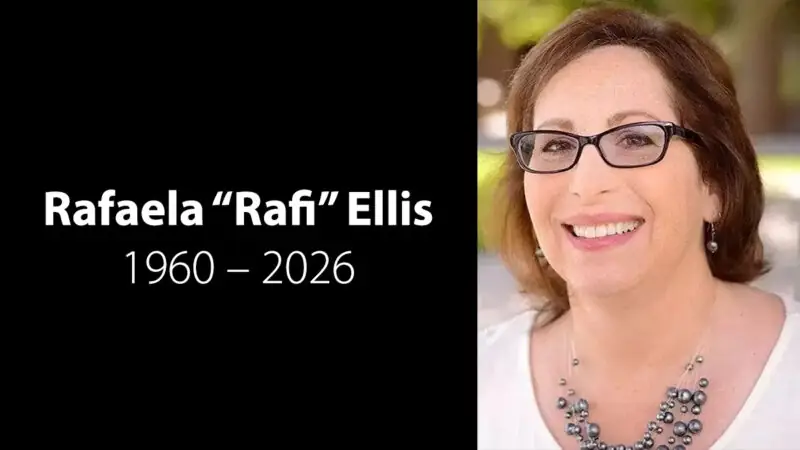
Rafaela “Rafi” Ellis believed deeply in the power of words. As a Professor of English, published author, skilled editor and lifelong advocate, she understood that words could teach, challenge, comfort and, when necessary, speak truth to power.
At Polk State College, where she taught English Composition and Literature for nearly two decades, she brought that conviction to her classroom, relationships with students and colleagues and service to the broader community.
Ellis, 65, passed away on May 3. Family, friends and colleagues joined together at the Polk Theatre in Lakeland on August 22 to celebrate her accomplished life.
“She had a fortitude, a strength and a passion for doing what was right, and that passion never left up until the very end,” said Professor of Humanities Aaron Morgan, a longtime colleague and friend. “She was passionate about activism, but more about what’s right and what’s wrong. She had unwavering courage and spirit.”
That passion was evident from the beginning of Ellis’ life. Born in Syracuse, and raised in New York and Pennsylvania, she developed an early love of the arts. She wrote, sang, played guitar, painted and immersed herself in museums, theater, film and literature.
Her academic path took her to the University of Pittsburgh and Merrimack College, where she graduated magna cum laude with a degree in English and was named a Presidential Scholar. She later earned a master’s degree in English and American Literature with honors from Villanova University.
Her master’s thesis on the Transcendentalists – writers and philosophers who emphasized the inherent goodness of people and nature and the power of the individual – foreshadowed the principles that would shape much of her life, as well as how her colleagues will remember her.
“She had a big heart for helping people,” Morgan said.
“She wore her love, her emotions and her thoughts on her sleeve,” Professor of English Lisa Rosa added.
“She devoted herself to helping every individual student in their own way,” Professor of English Eileen Murphy echoed.
“She was a fierce advocate for social justice,” Professor of English Carol Martinson said. “That’s how I remember her best.”
An innate passion for students
Before entering higher education, Ellis built a career in writing and publishing. She worked as an editor and writer for organizations including The Franklin Mint, Chelsea House and AAA’s Car & Travel Magazine. She also wrote essays and opinion pieces for the Orlando Sentinel and the Lakeland Ledger and later served as the theater and classical music reviewer for The Ledger.
Her professional life as a writer informed the professor she became.
“She had so many different talents – things you wouldn’t imagine from a college professor,” Murphy shared. “She was a writer and a creative person to her core, and she wanted to pass that on to other people.”
Ellis joined Polk State in 2007 as a full-time professor and her classes frequently had wait lists. Her colleagues remember her popularity as a reflection not simply of her expertise, but also of the extraordinary effort she put into helping students succeed.
“She gave individual conferences to each student every semester, which is difficult with six or seven classes, but she did it,” Murphy said.
Those conferences were symbolic of Ellis’ approach. She did not see teaching as simply delivering material to a classroom. She saw it as a relationship between professor and student, and an opportunity to recognize a student’s particular strengths, struggles and potential.
That commitment extended to all students, even those who may have been difficult to reach.
“She loved her students, and often those who may have seemed ‘unlovable.’ She would go the extra mile for every student,” Rosa said. “I would hear from students about how much they loved her and her classes. She gave them the tools they needed to be better writers.”
Martinson remembers sharing an office with Ellis that they affectionately called “the bullpen.”
“We talked about how to teach, what we were teaching – the good, the bad and the ugly,” Martinson shared. “I remember how knowledgeable she was about literature and writing.”
Ellis’ dedication extended beyond the classroom.
“There was a lot of editing, writing and providing feedback to the students. Like most teachers, she would give up her nights and weekends to provide that kind of feedback,” Morgan said. “She didn’t cut corners. That would have been the ultimate crime to Rafi.”
He shared that Ellis had even gifted a former student – a single mother – her car after graduation.
“She gave her car away,” he exclaimed. “That’s just who Rafi was.”
A fearless advocate
If Ellis was compassionate, she was anything but passive.
“She was the exact opposite of a doormat,” Morgan said.
Her colleagues repeatedly described Ellis as fearless and unwavering in her beliefs. She served on the Faculty Senate and became a strong voice for faculty rights and academic freedom.
“She was a fierce advocate for what she believed,” Martinson said. “She spoke up. Somebody has to do it, and she did it – and she was passionate about it.”
Ellis’ activism stretched well beyond Polk State. She was deeply involved in peace and social justice efforts, served as president of the Unitarian Universalist Congregation of Lakeland and later became a Universal Life Minister. She also served as secretary of the Homeless Coalition of Polk County.
“She was a big activist for people’s rights, especially for people who were neglected, suffering or abused,” Murphy said. “She was very passionate about her principles and ideals.”
That passion also found its way into her writing.
Murphy recalled Ellis’ involvement in Polk State’s Creative Writing Club, where students and colleagues learned more about the breadth of her creative work.
Ellis authored five books, numerous articles and other publications, including plays for young adults.
Rosa recalled that her political convictions were sometimes reflected in her writing through metaphors and other subtle means.
“She had strong political views, and no one could soften that,” Rosa said. “She was bold and expressive, but also very warm, loving and kind.”
A legacy that lives on
Ellis continued teaching and giving to others even as she battled cancer. Her colleagues were struck by the strength she displayed throughout her illness.
“She was always optimistic,” Murphy said. “Even at the end.”
Morgan remembers a particular outing at a museum in St. Petersburg with his wife, Ellis and her husband, Ron. They had walked quite a length in the Florida heat before arriving at the museum, which then presented a challenging flight of stairs.
Ellis, despite her illness, moved ahead of them full force.
“This lady was in extremely ill health, yet she was taking two steps at a time and leading the charge all the way into the gallery,” Morgan exclaimed. “She never gave up.”
She never gave up on her students, her colleagues, her community or the principles that guided her life.
At Polk State, her legacy can be found in the students who became better writers because she took the time to teach them, in faculty members who found courage in her advocacy and in colleagues who learned from her knowledge and creativity.
Martinson remembers a fierce advocate. Murphy remembers a writer dedicated to nurturing the creative spark in others. Rosa remembers a colleague who was warm, generous and deeply devoted to students. And Morgan remembers the fortitude.
“She was a role model for all of us,” he said.