

Faculty Focus: AgriPolk’s Jonathan Berkenfield connects classroom learning with career opportunities
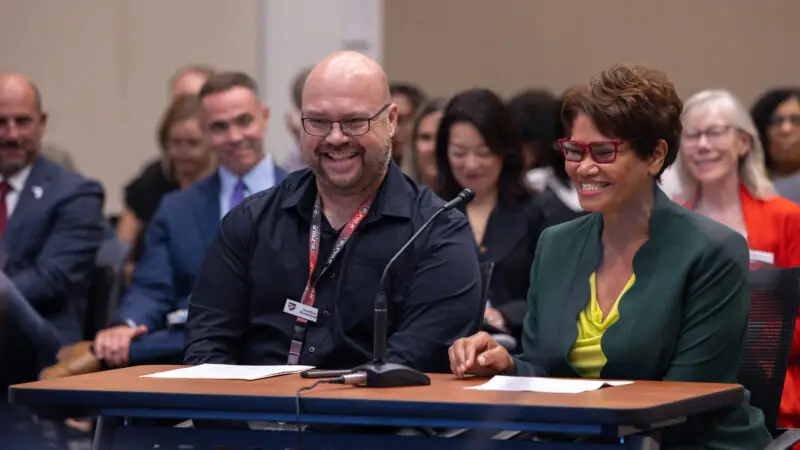
Before Professor Jonathan Berkenfield gives his students an assignment, he questions: “Why am I asking my students to do this?”
For Polk State Computer Systems and Business Analysis professor, who teaches within the College’s AgriPolk pathway, the answer needs to connect what students learn in the classroom with something they can use beyond it.
“I don’t believe in busy work,” Berkenfield said. “If I can’t explain how an assignment helps a student develop a skill, solve a problem, or prepare for something they may encounter outside my classroom, then I need to reconsider what I’m asking them to do.”
His practical approach has developed over a 20-year career in education, a profession Berkenfield hadn’t originally planned to enter. Teaching became his passion as he discovered the difference he could make in helping people recognize their abilities and explore possibilities for their futures.
“Students can see a connection between what they’re learning today and something they hope to do tomorrow,” he said.
Before joining Polk State full time, Berkenfield spent 13 years teaching Film and Journalism as part of Career and Technical Education at Lake Wales High School. He began his Polk State career as an adjunct at the JD Alexander Center in Lake Wales.
“Professor Bekenfield’s approach reflects what we want for every Polk State student—learning that has a clear purpose and prepares them for what comes next,” Polk State President Anastasios Kamoutsas said. “Through his teaching and collaboration with colleagues, he helps students build practical skills and recognize the opportunities available to them.”
Having spent much of his career in rural Lake Wales, he has seen the importance of making higher education accessible within the community. His commitment to expanding access also takes him to high schools, college and career events, and dual-enrollment nights, where he introduces students and families to options they are often unaware of.
Those local relationships helped him contribute to early discussions about AgriPolk. As Dean of Workforce Education Belkis Capeles and colleagues explored possibilities for agriculture-focused education, she asked Berkenfield to consider where technology coursework might intersect with that work.
He connected the team with agriculture teachers he knew through Lake Wales High School and developed early drafts of potential offerings that could eventually grow into Associate in Science pathways. His contributions supported the larger team as an Associate in Arts pathway with an agriculture focus took shape. As AgriPolk has developed, his involvement has shifted, though he remains available to contribute technology expertise as opportunities arise.
For student Vitor Macedo Albrecht, AgriPolk’s technology resources helped confirm his decision to enroll. He plans to pursue a bachelor’s degree in agricultural operations management at the University of Florida after completing his associate degree at Polk State.
“Seeing the resources at the ATC (Advanced Technology Center), particularly the agricultural drone, confirmed that the AgriPolk program has the tools I need to prepare for advanced agricultural studies and a career in the field,” Albrecht said
Collaboration also shapes Berkenfield’s work within his own program. He works closely with Professor John Stewart to identify connections between their disciplines and strengthen opportunities for students. He credits Capeles with encouraging him to contribute beyond his program and creating an environment where colleagues listen to one another and work across disciplines.
That shared focus on students carries into his classroom, where the goal is to help them put their knowledge to use. In the capstone course, students bring together skills from across their degree to build projects connected to their career interests. This summer, they completed projects that demonstrated their abilities and gave them work they could include in a portfolio for prospective employers.
For Berkenfield, those projects are a tangible example of the progress he hopes every student makes.
“When a student finishes one of my classes—or eventually leaves one of our programs—I hope, quite simply, that they leave better than when they arrived,” he said.
It is the same sense of possibility that helped him find his own place in education.
“I didn’t begin my career knowing that teaching would become my passion,” Berkenfield said. “I discovered it because people and opportunities along the way helped me find where I belonged. That’s what I hope Polk State can be for our students: a place that gives them the knowledge, skills, opportunities, and people who can help them discover where they want to go next.”